
I broke a spoke during the ride: can I continue cycling?

BICICITA admin
A broken spoke doesn't always mean you have to end your ride immediately, but it shouldn't be ignored either. Losing tension can cause the wheel to become misaligned, rub, and suffer further damage.
The definitive repair involves replacing the spoke and retruing the wheel. The question when this happens on the road is different: can I cycle back?
1. Stop and check the wheel
Find a safe place, get off your bike and check:
- If only one spoke has broken.
- If the tire has bumps, cracks or deformations.
- If the tire retains air and is correctly positioned.
- If the wheel spins freely.
- If the rim rubs against the brake pads, the frame, or the fork.
- If the brake disc rotates without locking up.
- If there are other loose or damaged spokes.
Slowly rotate the wheel and observe it from the front or the back. A small lateral movement is not the same as a deformation caused by continuous friction.
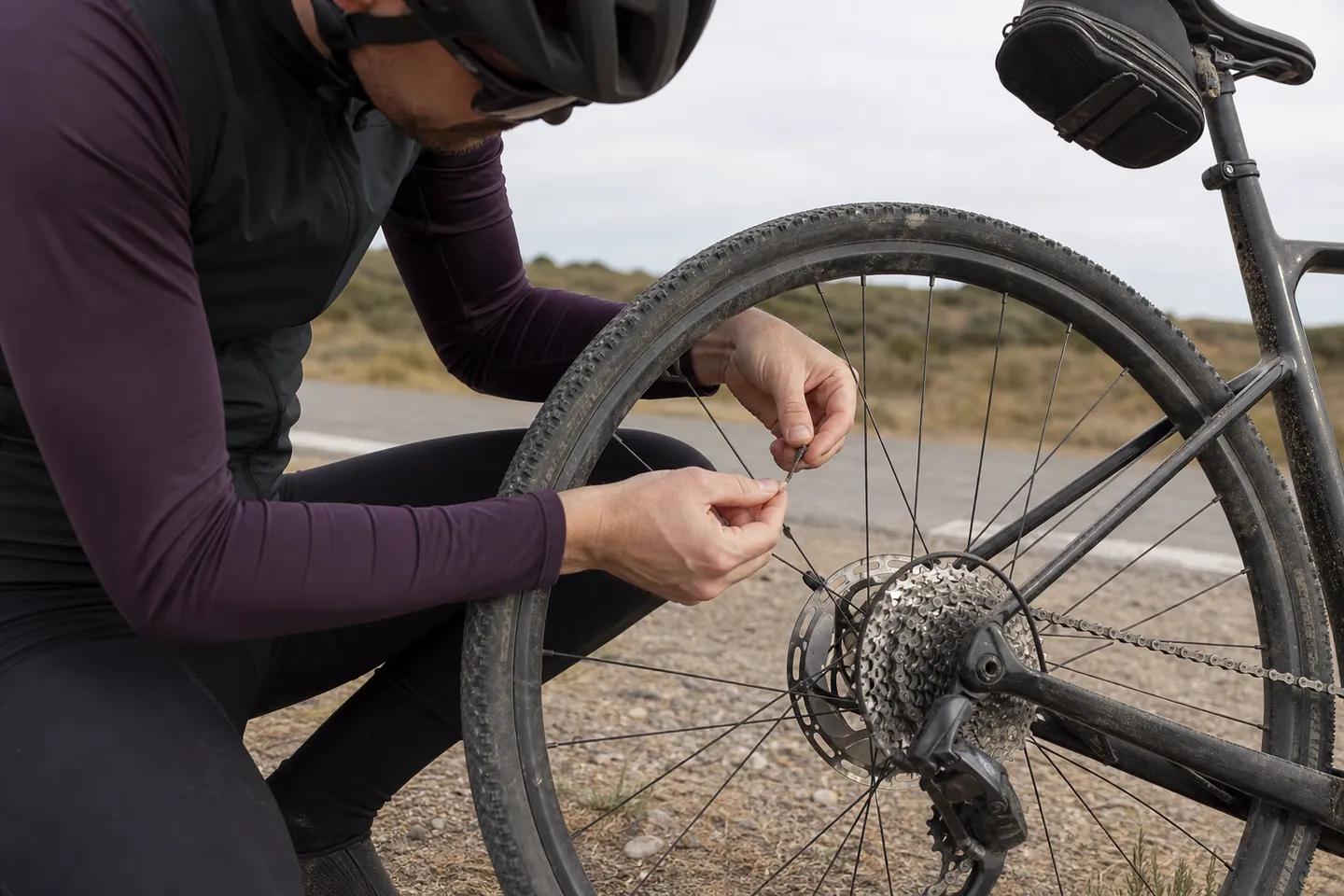
2. Hold the broken radius
A loose spoke can move, get caught, or scratch the bicycle.
If you can easily remove it, do so. If it remains attached at one end, secure it to a nearby spoke with tape, a cable tie, or something similar. The goal is to prevent it from rattling or spinning freely.
Do not bend it near the disc, the derailleur, or other moving parts.
3. When could you cycle back?
It may be possible to return with great caution when:
- Only one spoke has broken.
- The wheel remains reasonably centered.
- Turn without touching the frame or fork.
- The tire maintains pressure and is well seated.
- There are no visible cracks or deformations in the tire.
- The wheel feels stable.
In that case, take the shortest route, pedal slowly, and avoid potholes, bumps, sudden movements, and hard braking. Don't continue on your way as if nothing happened: the goal is to reach a safe place or a repair shop.
4. When should you stop pedaling?
Do not continue riding if:
- Several spokes have broken.
- The wheel is very off-center.
- The tire is rubbing against the frame or fork.
- The wheel is locked or has difficulty turning.
- The tire is cracked, dented, or clearly deformed.
- The tire has lost air or has partially come off.
- You hear loud noises or notice instability.
- You're not sure about the condition of the wheel.
In these situations, walking or asking for help will be more prudent than risking breaking the wheel completely or suffering a fall.
5. Can it be fixed with a spoke wrench?
A spoke wrench can allow for temporary truing, but only if you know which spokes to adjust and use the correct size.
Adjusting the tension without experience can further misalign the wheel, damage the nipples, or unevenly distribute the load. If the rubbing is minor and you know how to true wheels, make only minimal adjustments to achieve sufficient clearance and then return to the original position. This should not be considered a permanent repair.
6. The repair upon arrival
The broken radius must be replaced with one of the correct length, diameter, and type. Then the following is necessary:
- Center the wheel laterally and vertically.
- Check the tension of the rest of the spokes.
- Check the rim, hub, and nipples.
- Investigate the cause if other spokes have broken previously.
When a wheel breaks spokes repeatedly, simply replacing the last one that broke may not solve the problem. It may need a complete overhaul, re-spoked, or the replacement of some of its components.
Before the next route
Include the following in your regular bike check-up:
- Check that there are no loose or broken spokes.
- Spin the wheels to detect deviations.
- Check the rims and tires.
- Listen for any new creaks or noises.
- Carry a small cable tie or strong tape.
- Add a compatible spoke wrench if you know how to use it.
A broken spoke can be fixed. The important thing on the trail is to distinguish between a wheel that allows you to turn back with caution and one that makes it unsafe to continue.
💜 Enjoy, pedal, share.
BICICITA admin
Admin de Bicicita, ¿en que te puedo ayudar?