
Suspension tuning guide: everything you need to know about sag, hydraulics and rebound

BICICITA admin
A poorly adjusted suspension doesn't just make the bike feel strange — it tires you out more, takes away your control, and can make you lose confidence just when you need it most.
The problem is that most cyclists take their bikes out of the shop and never adjust the suspension. They adapt to the bike instead of adapting it to them. And that's a mistake they pay for on every ride.
The good news: Properly adjusting sag, rebound, and compression doesn't require being a mechanic or having special tools. You just need to know what you're playing and why.
At Bicicita we explain it to you from scratch, in a clear and practical way.
What is suspension and what is it used for?
Your bike's suspension has a very clear job: to absorb the impacts of the terrain so that the wheels maintain contact with the ground and you can control the bike at all times.
A properly tuned front fork improves traction, reduces arm fatigue, and gives you more confidence on descents. A correctly set-up rear suspension does the same for the rear end, completely transforming how the bike feels on technical singletrack.
There are three fundamental parameters you need to know: sag , rebound , and compression . Each has its function, and the order matters: you always start with sag.
Step 1: Adjust the sag
Sag is the amount the suspension compresses simply under your weight on the bike in a riding position. It's the starting point for any setup—if the sag isn't right, everything else will be wrong.
Why is this so important? If the suspension is too stiff (too little sag), the wheel will bounce off obstacles instead of absorbing them. If it's too soft (too much sag), it will dive into every impact, and you'll lose pedaling efficiency.
How much sag do you need? As a general reference:
- XC or gran fondo use: 15-20% of the total route
- Trail and all-mountain: 25-30%
- Enduro and downhill: 30-35%
How to measure it:
- Place the rubber ring (or a cable tie) on the fork stem, close to the top edge.
- Get on the bike in a normal riding position — with the equipment you would normally wear.
- Get off carefully without bouncing.
- Measure the distance between the ring and the top edge: that's your sag in millimeters.
- Divide it by the total distance and multiply by 100 to get the percentage.

To adjust the sag, regulate the air preload with a suspension pump (more pressure = less sag, less pressure = more sag). If your suspension is coil-spring, adjust the preload with the appropriate wrench.
Step 2: Adjust the rebound
Rebound controls the speed at which the suspension returns to its original position after compression. It's the adjustment most noticeable on the track and the one that confuses cyclists the most.
Rebounds too quickly: the suspension returns so fast that it throws you upwards on consecutive impacts. The bike feels twitchy and uncontrollable.
Too slow rebound: the suspension doesn't have time to recover between impacts and keeps piling up — in a technical section you can reach the bottom of the travel without intending to.
How to find the sweet spot: Find a ramp or low curb. Drop the front wheel from about 20-30 cm without holding the handlebars. The fork should return to its upright position smoothly, without bouncing back up more than once. If it bounces, more rebound (slower). If it takes too long, less rebound (faster).
The rebound adjustment is usually located at the bottom of the fork — a red or orange dial with tortoise and hare arrows.

Step 3: Adjust the compression
Compression controls the resistance the suspension offers when it compresses. In other words: how much effort it takes to compress when you hit something.
Many suspensions have two types of compression adjustment:
Low-speed compression (LSC): This doesn't relate to the bike's speed, but rather to the speed of the suspension's movement. It affects smooth, progressive impacts, such as pedal bob. It's the most useful adjustment for balancing efficiency and comfort.
High-speed compression (HSC): This affects sudden, rapid impacts, such as hitting a root or a rock. It's only found on mid-to-high-end suspensions. Adjust it carefully—small changes can have a big impact.
Starting point: always begin with the dials in the middle position recommended by the manufacturer and adjust them one by one, going for a ride between each change to notice the difference.

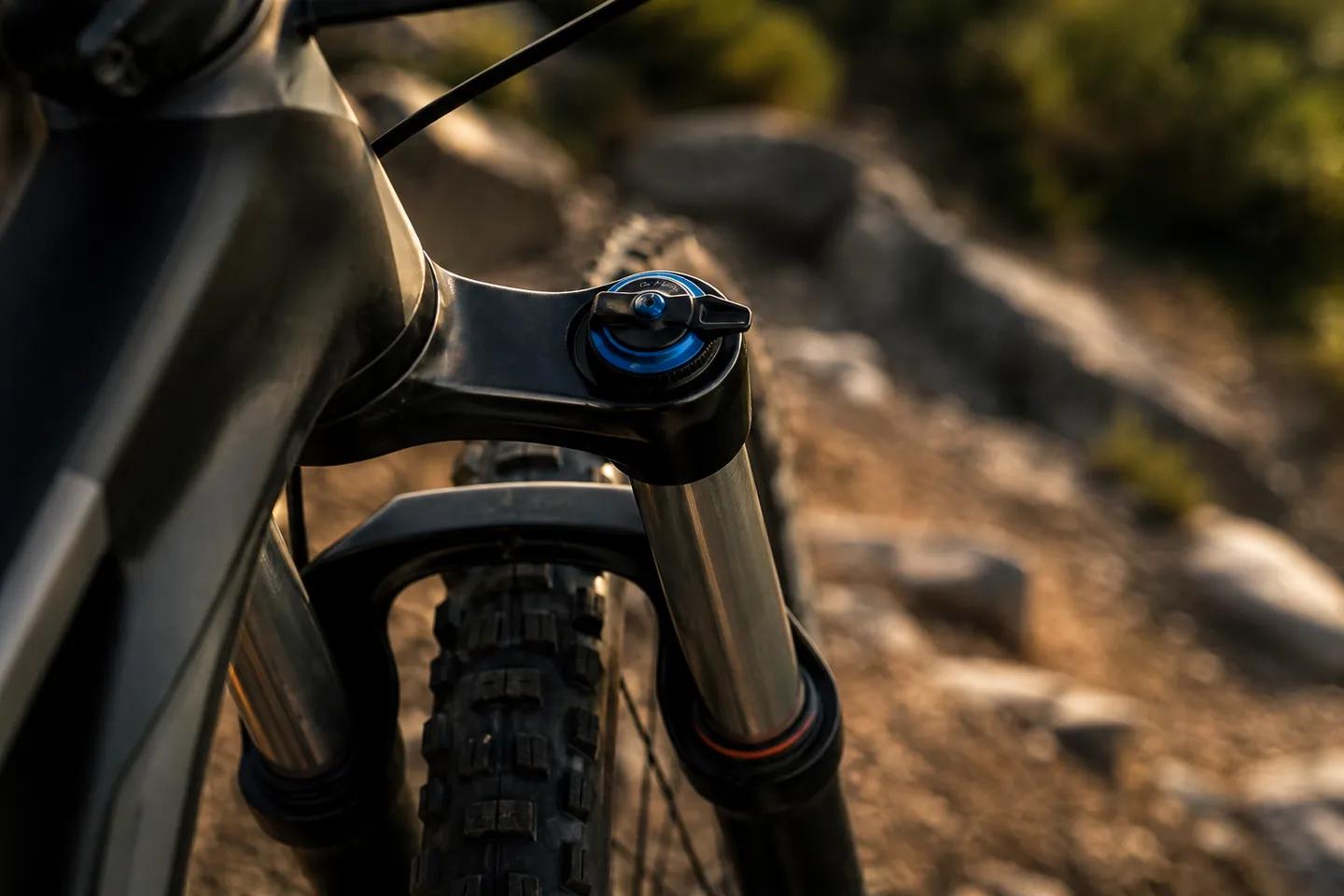
Step 4: Lockout and Firmness Modes
Most modern suspensions include a full or partial lockout system—the famous lockout . It's useful on long climbs on asphalt or dirt tracks, where an active suspension only robs you of energy.
Some systems have three positions: open, medium (trail), and locked. Use them according to the terrain, but remember to unlock before entering a technical descent—it's easier to forget than you think.
One final tip: write down your settings
Once you find a setup you like, note down the number of clicks for each adjustment. Suspensions have position memory, but you might forget. A simple notepad on your phone with "rebound: 8 clicks, compression: 5 clicks" will save you a lot of time the next time someone touches your bike or you change terrain.
And if you ever get lost with the adjustments, we at Bicicita are here to help. A good suspension setup is one of the biggest improvements you can make without changing any parts.
NOTE: And be aware that all of this applies equally to the rear suspension, not just the fork.
BICICITA admin
Admin de Bicicita, ¿en que te puedo ayudar?