
The gearbox has malfunctioned mid-departure: what to look out for and how to get out of this situation

BICICITA admin
The chain skips, the gear won't shift, there's a rattling noise with every pedal stroke. Adjusting a gear system properly is a job for a workshop and an expert hand. But on the road, the goal is different: to pedal home. And for that, it's almost always enough to check the gears in the right order.
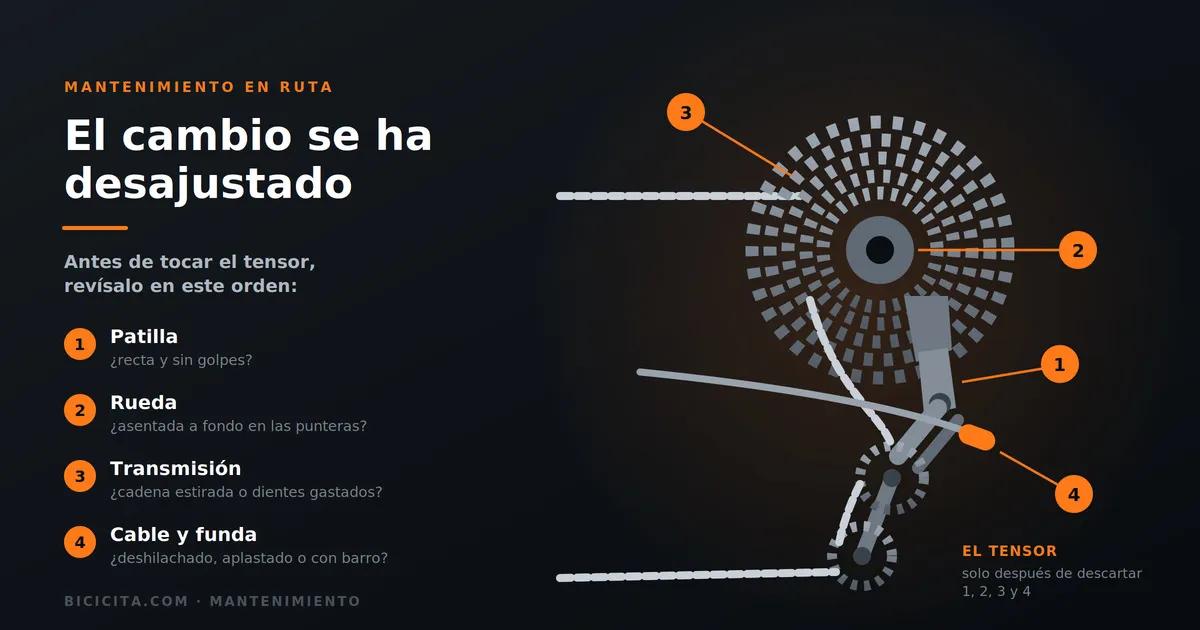
Before touching anything: the problem is almost never the tensioner
The temptation is to go straight to the screw. Mistake. Most derailleurs that "lose adjustment" on a ride haven't lost cable tension: they have another problem that no amount of adjustment will fix. Check this first, in this order.
1. The sideburn: straight and without bumps?
It's the number one cause. A bump on the ground, a silly fall, or simply the bike lying on its side in the trunk with the derailleur hanging off, and the derailleur hanger gets bent a couple of millimeters. Enough to prevent any sprocket from engaging smoothly.
Stand behind the bike and look: the derailleur cage should be parallel to the sprockets. If it's angled outwards or towards the wheel, that's your problem. If you have a spare derailleur hanger, replace it. If not, you can try to straighten it carefully and gradually, keeping in mind that bent aluminum can break. And if it's badly bent, don't force it: ride in an intermediate sprocket without touching the derailleur and avoid the largest sprocket at all costs, as that's where the derailleur ends up embedded in the spokes.
2. The wheel: is it properly seated?
It seems obvious, but it's very common after a puncture. A wheel that's slightly bent at the dropouts changes the alignment of the entire derailleur. Loosen the axle or the quick-release skewer, make sure the wheel seats all the way down, and tighten it again.
3. The transmission: Is it worn out?
A stretched chain or sprockets with sharp, shark-fin-shaped teeth will skip under load, even if the gearing is perfect. This is especially true when you stand up from the saddle. If the skipping only occurs when you shift hard and always on the same sprockets, suspect wear. On the road, there's no solution: use the sprockets that don't skip and make a note to check the chain tensioner on your return.
4. The cable and the case: anything strange?
A frayed cable, a crushed housing, or dried mud on the ride can slow the cable, causing the shifting to be slow or not at all. Inspect it thoroughly. A cable that's about to break isn't just adjusted; it needs to be repaired until you get home.
If all that's okay, now then: the tensioner
The tensioner is the small threaded wheel where the cable enters the derailleur (on some bikes it's on the shifter or the housing). It's the only adjustment you should make while riding.
-Put the chain on an intermediate sprocket and pedal with the rear wheel in the air.
- If it struggles to shift to the larger gears or makes a noise when trying, the cable lacks tension: unscrew the tensioner, pulling it outwards from the derailleur body.
- If it's difficult to shift to the smaller gears , there's too much tension: screw the tensioner inwards.
- Always adjust in quarter-turn increments . Turn, pedal, shift up and down, and try again. Rushing with the tensioner can turn a slight misalignment into a serious one.
Visual reference: with the chain on an intermediate sprocket, the upper pulley of the derailleur should be directly below that sprocket, aligned with it.
What not to touch on the road
The two limit screws, marked H and L, restrict how far the derailleur can move. The L screw prevents the derailleur and chain from getting caught in the spokes. If no one has touched them, they're fine: don't move them while riding in a ditch. An improperly adjusted limit screw can turn an uncomfortable ride into a wrecked wheel and derailleur.
Electronic changes
Di2 and AXS don't have cable tensioners, but they do offer micro-adjustments via buttons or the app. First and foremost, check the battery: an electronic shifter with a low charge can behave erratically. And the derailleur hanger remains the prime suspect, just as it is with a mechanical shifter.
If nothing works
Find a sprocket that won't skip, leave it there, and ride back slowly, without crossing the chain to the opposite chainring. And if the derailleur hanger is completely broken, there's one last resort: shorten the chain and turn the bike into a single-speed. It's not elegant, but you'll get back by pedaling.
Adjusting a derailleur is a skill, and you learn it by hand. To avoid being caught off guard by a misalignment, check the derailleur hanger before heading out using our bike checklist before every ride.
Galería de fotos
1 / 1
BICICITA admin
Admin de Bicicita, ¿en que te puedo ayudar?