
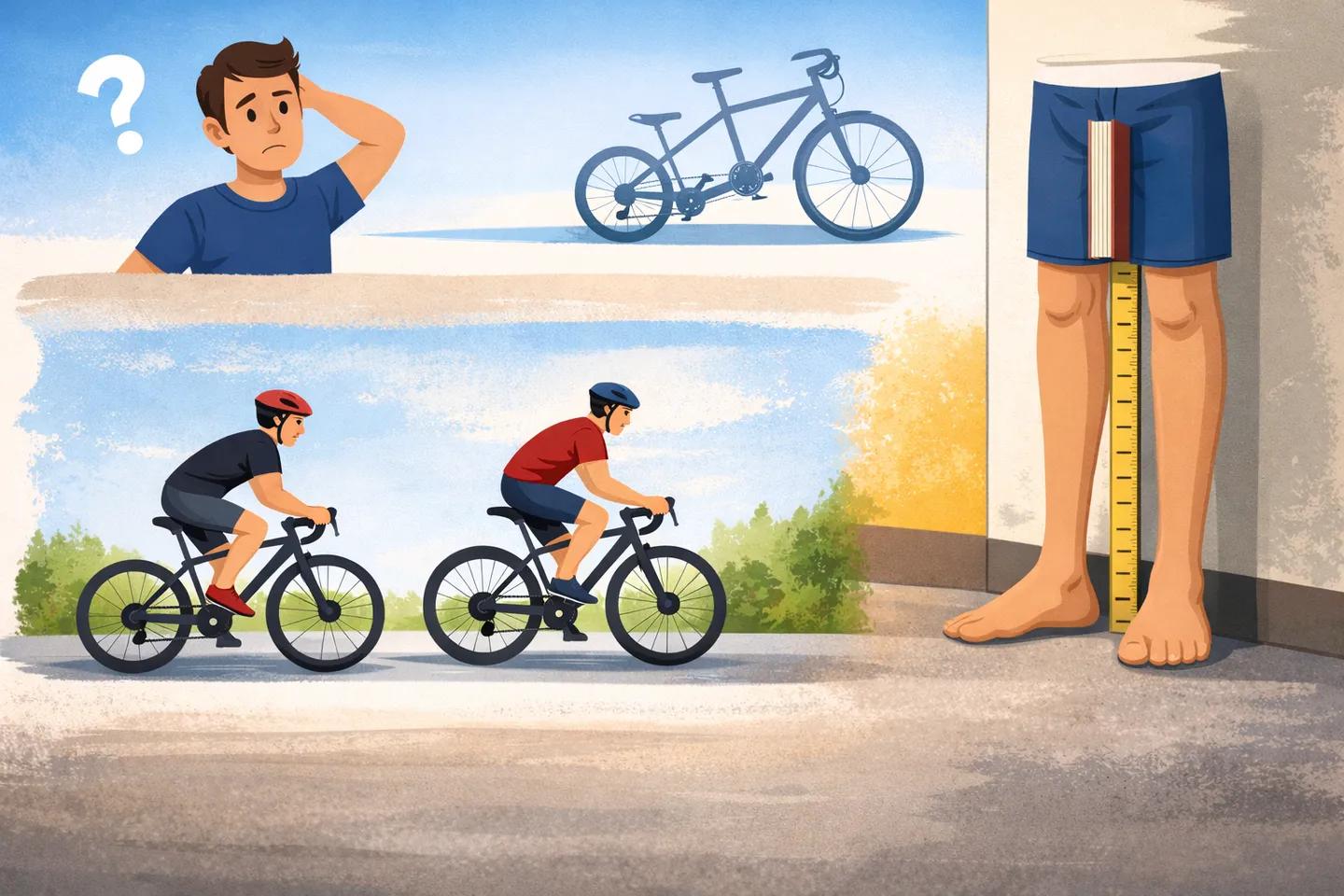
What's my bike size? A quick guide to getting it right (without going crazy).

BICICITA admin
The right size depends on your body, your riding style, and how you like to ride. Here's a simple method to get it right and avoid costly mistakes.
1) The uncomfortable truth: “I’m X years old → size Y” isn’t enough. Two people of the same height may need different sizes due to: Leg length (inseam), Torso and arm length, Flexibility and posture (more comfortable vs. more aggressive), Type of bike (road, gravel, MTB, urban), Geometry of each brand/model. Conclusion: Use height as a guide, but decide based on inseam and adjust according to posture.
2) Quick Method (2 minutes) to find your base size You need: a wall, a book, and a measuring tape. Step A — Measure your inseam Barefoot, with your back against the wall. Place a book between your legs, above your head, as if it were a saddle. Measure from the floor to the top of the book. 👉 That number (in cm) is your inseam. Step B — Calculate an approximate size (starting point) Road (frame size in cm): Inseam × 0.67 MTB/Gravel (more approximate size): Inseam × 0.59 (approx. in cm) Note: MTB and gravel bikes almost always use S/M/L or numbers that vary depending on the brand. This is NOT an exact science. It's to narrow down the options.
3) Guideline table by height (if you CANNOT measure the inseam)
Road (approx.)
150–160 cm → 47–49
160–170 cm → 50–52
170–175 cm → 53–54
175–180 cm → 55–56
180–185 cm → 57–58
185–190 cm → 59–60
190+ cm → 61–63
MTB / Gravel (approx.)
150–163 cm → S 1
63–175 cm → M
175–185 cm → L
185–195 cm → XL
Honest warning: this chart is very inaccurate if you have long legs (women) or a long torso (men). Use it only as a first screening tool.
4) The key that almost no one looks at: “Reach” and “Stack” (in 30 seconds)
If you're comparing models or are between sizes, look at this in the geometry:
Reach = how much you "stretch" towards the handlebars.
If you have neck/shoulder pain or want comfort → shorter reach (or a smaller size). Stack = how high the front sits. If you want a more upright posture → higher stack (or a larger size/more spacers).
Rule of thumb:
If you want a comfortable posture (long routes, gravel, city) → prioritize stack.
Want an aggressive stance (fast road, performance) → prioritize reach and control.
5) I'm between two sizes: should I go up or down? It depends on what you value, but in general:
✅ Choose the smaller size if:
Do you want more control (MTB)
Looking for a sporty posture?
You have short arms/torso
Do you like a "nervous" bike?
✅ Choose the larger size if:
You're looking for comfort and stability
You have long legs and/or a long torso.
You take long, quiet routes
Brutally useful rule: it's easier to "make a small bike bigger" (stem, seatpost) than to "make a large bike smaller" (it becomes cumbersome and you don't fit in).
6) Quick adjustment to confirm the size is reasonable. Saddle height (approx.): Inseam × 0.885 (from the center of the bottom bracket to the top of the saddle). Then validate the feel:
Pedal down: knee slightly flexed (not locked).
You don't sway your hips while pedaling. You don't feel like you're "over the handlebars" or that you're too hunched over.
If you fail here, the size may be wrong or the fit is wrong.
7) Typical mistakes (the ones that cost money)
Buying “a size larger for comfort” → usually ends in lower back/neck pain.
Going by one brand's size and assuming another will be the same → false. Ignoring reach/stack and only looking at the number (54, M, L).
Just adjust the saddle and forget about stem/handlebars/setback.
8) Want to get it right without overthinking it? Do this on Bicicita. Post your question (or ask in your group) with this information and we'll help you out, fellow cyclists: Height, Inseam, Bike type (road / MTB / gravel / urban), Intended use (long rides, performance, comfort, bikepacking…), Model/brand if you already have one in mind
Galería de fotos
1 / 1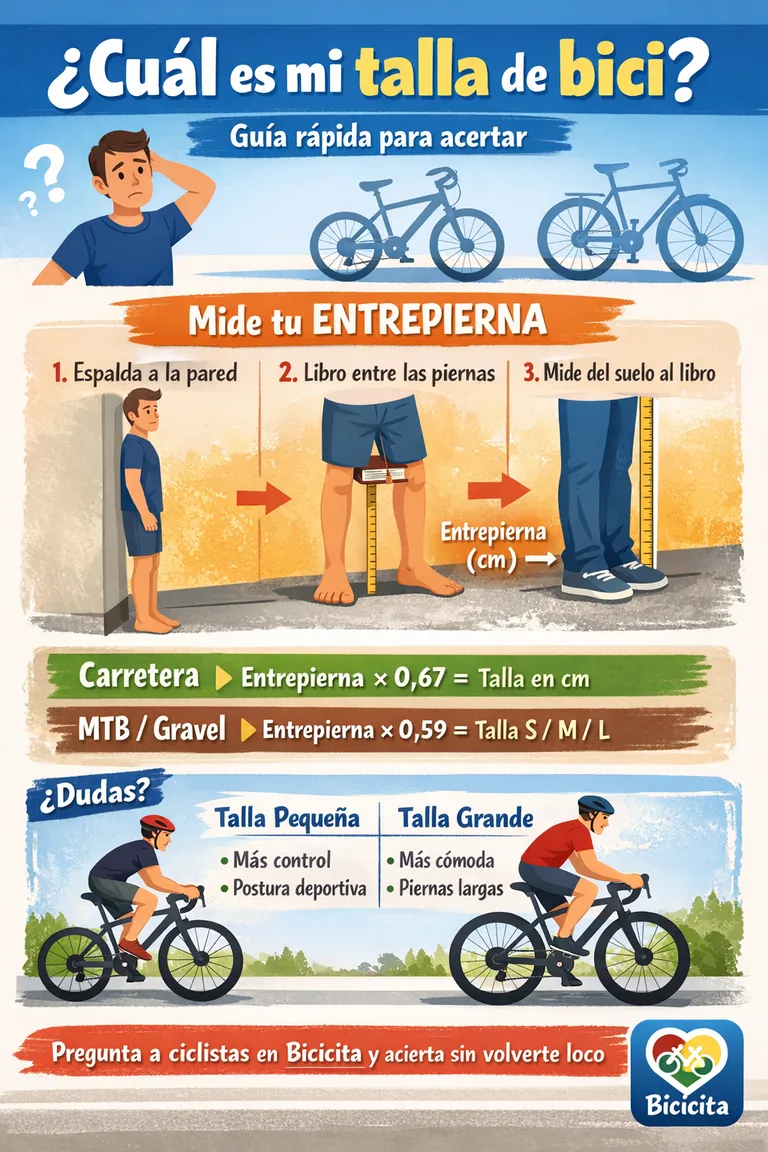
BICICITA admin
Admin de Bicicita, ¿en que te puedo ayudar?